



Endozoicomonas acroporae enhances coral thermal resilience
Over the past few decades, frequent marine heatwaves have driven widespread coral bleaching and mass mortality globally. Consequently, enhancing corals' resistance to thermal stress has become a critical focus in marine biology. A research team led by Research Fellow Sen-Lin Tang, Assistant Research Fellow Yi-Jyun Luo, and Postdoctoral Researcher Chih-Ying Lu from the Biodiversity Research Center at Academia Sinica has discovered that applying the coral endosymbiont Endozoicomonas acroporae Acr-14ᵀ as a probiotic significantly enhances corals' thermal tolerance.
In tank experiments, Stylophora pistillata corals subjected to heat stress but treated with the probiotic demonstrated significantly higher photosynthetic efficiency and better color scores than the untreated control group (Figure 1A). The team found that E. acroporae Acr-14ᵀ forms "coral-associated microbial aggregates (CAMAs)" within coral tissue. This probiotic not only suppresses potential pathogens but also promotes the growth of beneficial bacteria associated with coral health. Furthermore, transcriptome and single-cell transcriptome analyses revealed that the probiotic treatment markedly reduces protein folding stress and apoptotic signaling pathways while mitigating heat-induced catabolic responses (Figure 1B). This coordinated cascade may help corals maintain energy homeostasis, thereby stabilizing their relationship with symbiotic algae and boosting overall thermal tolerance. As the world’s first study to unveil how E. acroporae Acr-14ᵀ fortifies the coral host against heat, this research establishes a vital model for understanding how host-microbiome interactions can strengthen coral resilience in warming oceans.
This study was funded by Academia Sinica and the National Science and Technology Council (NSTC), with critical technical support from the High-Throughput Sequencing Core Facility at Academia Sinica. Co-author Dr. Naohisa Wada from the Okinawa Institute of Science and Technology Graduate University (OIST) also provided expert guidance. The findings were published in The ISME Journal (IF: 10.2) on July 1, 2026.
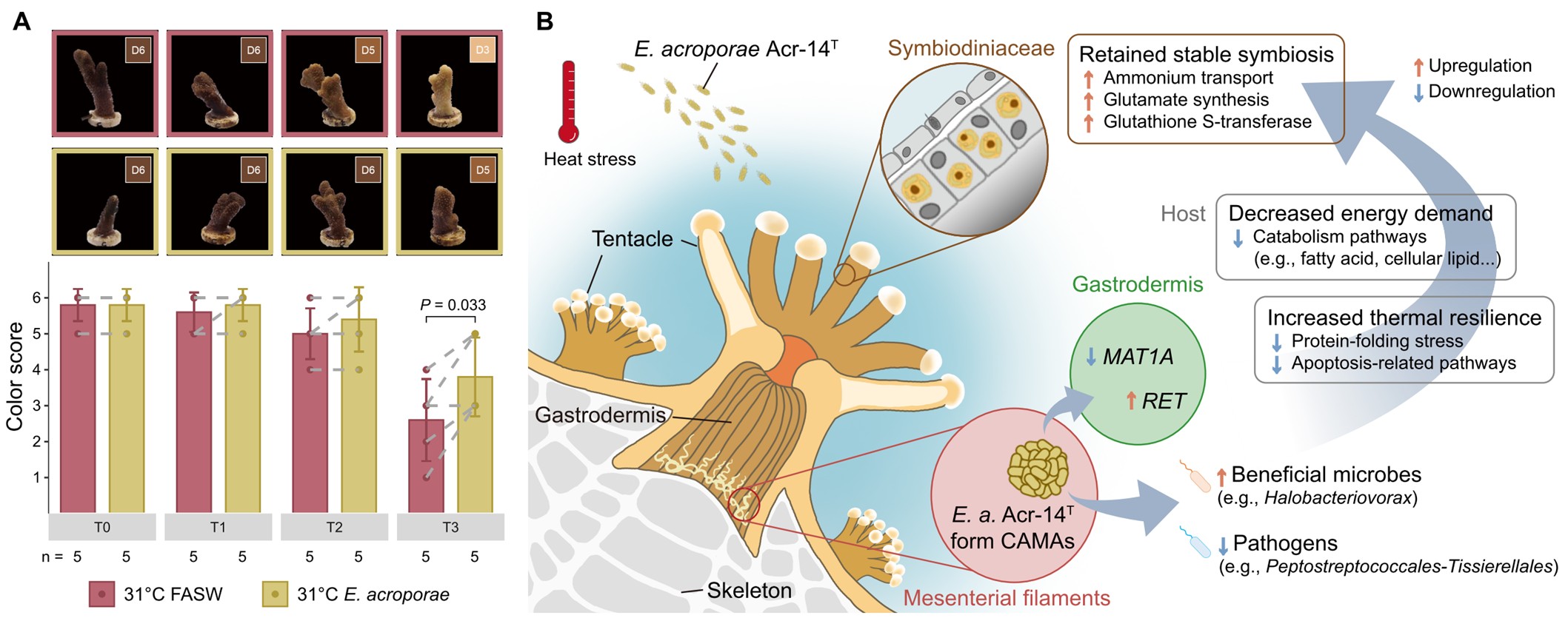
Figure 1. (A) Coral color scores of nubbins collected at four sampling time points, with representative photographs of nubbins from colony c. Grey dashed lines connect data from the same colony across treatments. Dots represent individual data points. (B) Schematic summarizing the proposed model of how E. acroporae Acr-14T enhances the thermal resilience of S. pistillata.