




“Ear stones” reveal clues to the evolutionary history and ecological adaptations of fishes
Every fish carries tiny stones in its inner ear called otoliths. These “ear stones” help fish hear and maintain balance. Our newly published study has further shown that otoliths can reveal important clues about the evolutionary history and functional adaptations of fishes.
The research focused on croakers (Sciaenidae), a family of fishes known for their ability to produce sounds. Using high-resolution 3D geometric morphometrics, we examined both the overall shape of the otolith and its fine structure.
We compared evolutionary trees based on otolith morphology with a molecular tree derived from DNA data. The overall otolith shape carried a weak but detectable signal of ancestry, whereas the otolith fine structure appeared to be influenced more strongly in response to ecological conditions. These results show that closely related species do not always have similar otoliths and that distantly related species may independently develop comparable forms.
We also detected a weak yet significant correlation between overall otolith shape and swim bladder shape. The swim bladder is an organ that helps sciaenids produce sounds and enhances sound reception. This relationship suggests that auditory function and acoustic communication may partially influence otolith evolution in sciaenids. Finally, we showed that fish otoliths retain two overlapping histories: an evolutionary signal inherited through shared ancestry and morpho-functional adaptations.
What makes this research especially promising is its use of 3D geometric morphometrics. Because otoliths are abundant and are often preserved as fossils, this approach can also be applied to extinct fish species. Comparative analyses of fossil and living otoliths may allow scientists to reconstruct the evolutionary trajectories of fish morphology, sensory systems, and ecological adaptations across geological timescales.
The study was published in Cladistics and was authored by Dominique P. Mediodia, a PhD student in the Biodiversity Program of the TIGP, under the supervision of Dr. Chien-Hsiang Lin of the BRC. The research was conducted in collaboration with Dr. Valentin Fischer and Dr. Roland Sookias of the Evolution and Diversity Dynamics Laboratory (EDDyLab) at the Université de Liège, Belgium.
This study was supported by the National Science and Technology Council, Taiwan, the Career Development Award from Academia Sinica, and the Fonds de la Recherche Scientifique–FNRS Bilateral Mobility Project through the Université de Liège, Belgium.
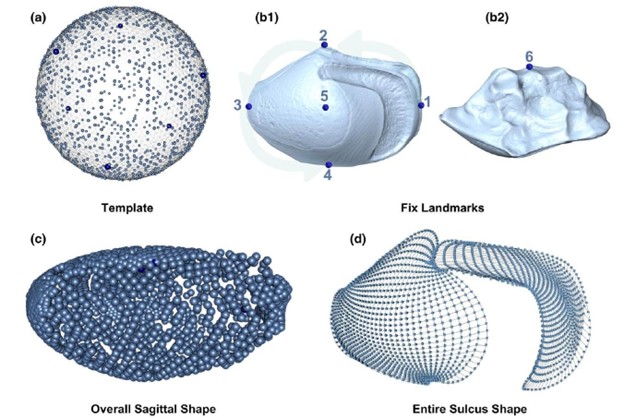
3D shape analysis of sciaenid otoliths. 3D geometric morphometrics was used to quantify sciaenid otolith morphology and assess how otolith shape is influenced by phylogenetic relationships and ecological adaptation.
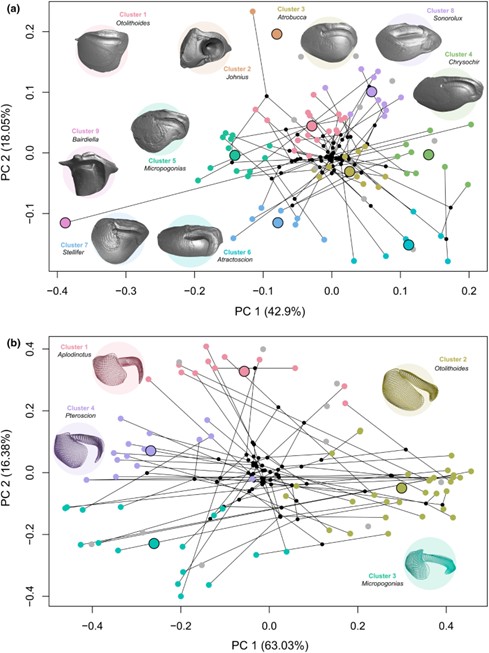
Morphospace analysis of otolith shape. Sciaenid otoliths occupy distinct morphogroups in morphospace, indicating that otolith morphology reflects both phylogenetic relationships and functional adaptation.
Article link: https://doi.org/10.1111/cla.70054
_960.jpg)
